
Summary: The Hidden Cost of VAS Vendor Sprawl
- Vendor sprawl happens when MNOs accumulate multiple VAS providers over time, creating a fragmented ecosystem of disconnected platforms and processes.
- The biggest costs are often hidden. Beyond licence fees, operators face growing integration, maintenance, support, and vendor management expenses.
- Complexity scales quickly. Every new vendor adds contracts, SLAs, technical dependencies, and operational overhead.
- Data becomes siloed. Disconnected systems make it harder to gain a unified view of customers, services, fraud, and performance.
- Innovation slows down. New services take longer to launch when multiple platforms require integration, testing, and coordination.
- More vendors do not always reduce risk. They can increase security exposure, create additional dependencies, and make future migrations more difficult.
- Strategic consolidation can improve agility. A unified VAS environment helps reduce costs, simplify operations, accelerate service delivery, and improve visibility across the business.
Mobile Network Operators worldwide are dealing with the growing challenge of vendor sprawl in their Value-Added Services (VAS) environment. The costs go far beyond licence fees and often include integration overhead, operational duplication, fragmented analytics, and delayed service innovation..
What often starts as a sensible way to access different specialist solutions can, over time, turn into a disconnected mix of systems. This hidden complexity can drain resources, slow down progress, and make innovation harder.
If you are reviewing your current VAS setup or looking at consolidation options, it is important to understand what vendor sprawl means and how it affects business decisions.

Defining Vendor Sprawl in a VAS Environment
VAS vendor sprawl happens when Mobile Network Operators build up multiple Value-Added Service providers over time. Each vendor may deliver a specific capability such as:
- Messaging
- Interactive voice response
- Analytics
- Customer engagement tools
Instead of working within one connected ecosystem, the business ends up with a mix of separate systems. Each system has its own interface, protocol, billing method, and support process.
Think of it like running a restaurant where the point-of-sale system comes from one vendor, inventory management from another, staff scheduling from a third, and the loyalty programme from a fourth. Each system may do its own job, but they do not connect smoothly. Daily work then depends on manual coordination, repeated data entry, and ongoing troubleshooting when systems do not align.
For MNOs, this can mean having separate platforms for:
- USSD services
- Bulk messaging
- Fraud detection
- Revenue assurance
- Customer analytics
Each platform may need its own technical support, contract discussion, and integration work to function as part of one operating environment.
The word sprawl describes how this complexity grows over time. As telecom operators accelerate digital transformation initiatives, many are now reassessing whether fragmented VAS ecosystems can support modern requirements. New business needs appear, and instead of replacing old systems, it often feels easier to add another specialist vendor. Over time, what looked manageable can become difficult to control.
How Vendor Sprawl Affects VAS Buying Decisions
If you are reviewing VAS solutions or considering changes to your current setup, it is important to understand the impact of vendor sprawl. It shapes much more than the upfront cost. It affects long-term scalability, operational efficiency, and the value you get from your technology investment.
Integration Complexity Multiplies Your TCO
Every new vendor introduces additional integration layers across SMPP gateways, APIs, billing systems, authentication frameworks, routing engines, and reporting environments.. You are not only paying for software licences. You are also paying for custom APIs, middleware, and ongoing maintenance to keep systems synchronised.
A solution that looks cost-effective at first can become expensive once engineering time and support effort are included.
Operational Overhead Scales Non-Linearly
In telecom environments, this complexity often extends across NOC operations, fraud management teams, routing engineers, billing departments, and compliance workflows. Each vendor brings its own demands. Your team may need to manage, separate relationships, different service level agreements, individual security reviews, and platform-specific technical knowledge.
That means more time spent learning different systems, solving issues across platforms, and coordinating with several suppliers when problems affect more than one tool.
Data Fragmentation Limits Intelligence
Strong telecom performance depends on clear, data-driven insight. When customer data, network analytics, and service metrics sit in different systems, it becomes difficult to get a full picture.
You may have one vendor handling fraud detection and another supporting churn prediction, but if the systems do not work together, it becomes hard to connect those insights and act on them.
Vendor Lock-in Multiplies
Many teams assume that using several vendors will prevent dependency on one supplier. In reality, it can create dependency in several places. Each system builds up historical data, custom settings, and process dependencies.
That makes change harder. If you decide to consolidate later, you may face several migration projects instead of one.
Innovation Slows Down
In telecoms, speed matters. When every new service depends on multiple vendors, integration testing, and compatibility checks, launch timelines become longer. This can slow down your ability to respond to new market needs and internal priorities.
Common Misunderstandings About Vendor Sprawl Costs
Misconception #1: “Best-of-breed always delivers better results”
Many decision-makers believe that choosing the leading specialist in each VAS category will produce stronger results overall. The problem is that telecoms works as a connected ecosystem.
A strong fraud detection tool loses value if it cannot share live insight with your customer analytics platform. Integration issues can cancel out the strengths of individual specialist tools.
Misconception #2: “We can integrate everything seamlessly”
Technical teams often underestimate how difficult integration can be, especially in real-time telecoms environments. APIs may be available, but building the speed and reliability needed for VAS often requires a large amount of custom work.
What seems simple in a vendor demo can turn into months of integration effort in a live environment.
Misconception #3: “Vendor diversification reduces risk”
Avoiding a single point of failure can make sense, but too many vendors can introduce new risks. You increase the number of security touchpoints, raise the chance that one supplier will face problems, and make failure scenarios harder to manage across connected systems.
Misconception #4: “We only pay for what we use”
Usage-based pricing can sound attractive, but multiple vendors often mean:
- Multiple minimum commitments
- Multiple setup costs
- Multiple support agreements
You may also end up paying for overlapping features or miss out on purchasing efficiencies that come with consolidation.
Misconception #5: “Individual vendor relationships are easier to manage”
Managing several smaller vendor relationships may sound straightforward. In reality, coordinating troubleshooting, feature requests, and planning across multiple suppliers can create a heavy management burden.
The Bottom Line on Vendor Sprawl
Vendor sprawl is one of the hidden cost areas in modern telecoms operations. Individual vendor fees may look manageable on their own, but the combined effect can create serious pressure across integration, operations, data visibility, and speed to market.
The answer is not necessarily to eliminate every vendor, but to strategically simplify and unify the telecom service delivery ecosystem wherever operational duplication and integration debt reduce agility.. The real need is to take a strategic total cost of ownership view of your VAS ecosystem. That means looking not only at what each solution does on its own, but also at how solutions work together, scale together, and support long-term business goals.
Understanding what vendor sprawl is and the real cost behind it is the first step towards building a VAS Operators that modernize and consolidate their VAS ecosystem are often able to reduce operational overhead, accelerate partner onboarding, simplify integrations, and improve service agility across messaging, voice, and digital services.
A structured vendor consolidation assessment can help MNOs identify hidden operational costs, integration bottlenecks, and opportunities to modernize legacy telecom workflows through unified digital platforms.
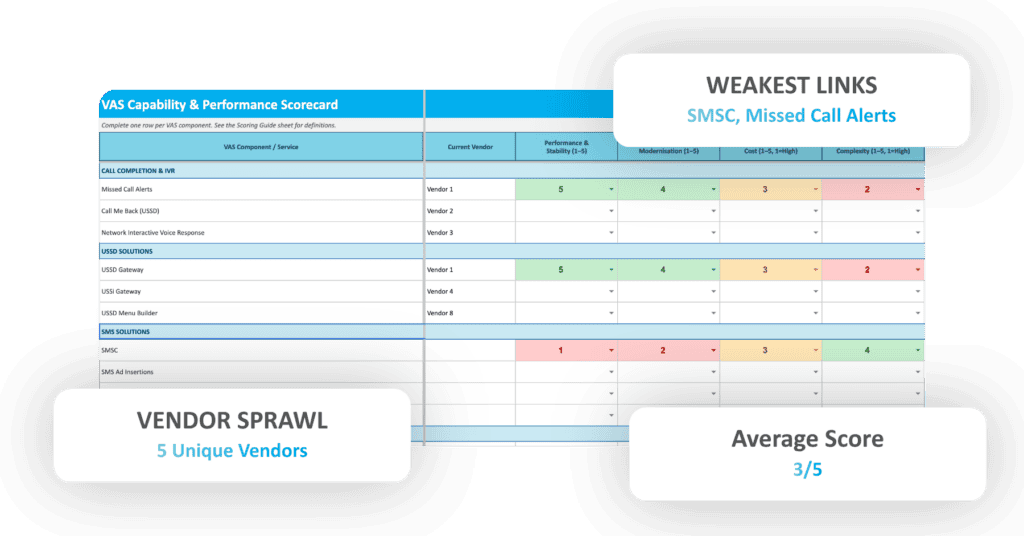
Get a clear view of your VAS performance
Download the scorecard to quickly assess your current VAS environment, uncover inefficiencies, and identify opportunities for optimisation and consolidation.

Matthew Seabrook leads the NGVAS business unit at Adapt IT Telecoms, driving next-gen telecom solutions. With 30+ years in Telecoms, ICT, and IT, his expertise in sales, operations, and professional services enables him to strategize effectively, optimise networks, and unlock new revenue. A servant leader, he fosters growth, removes obstacles, and champions innovation, ensuring lasting partnerships and a thriving, people-centric team.