
Telecom operators rely on a growing network of external vendors across messaging, billing, analytics, connectivity, customer engagement, and value added services. Each new supplier adds another integration point, another data handoff, and another potential compliance gap. For VAS teams, this can affect service continuity, customer experience, reporting accuracy, security oversight, revenue assurance, and the speed of operational decision-making.
Third-party vendor risk management helps operators identify, assess, monitor, and reduce vendor-related risk across commercial, operational, technical, security, compliance, and service-delivery areas.. In telecoms, however, the challenge is not only weak controls. In fragmented VAS environments, the vendor model itself can raise risk. This is especially true in VAS environments, where multiple platforms may touch subscriber data, charging events, messaging flows, consent records, campaign activity, customer engagement channels, and service analytics.

What Is Third Party Vendor Risk Management?
Third party vendor risk management is the process of identifying, assessing, monitoring, and reducing the risks created by external suppliers and service providers.
In telecoms, TPRM goes beyond legal,procurement and annual questionnaire reviews.. It also covers service uptime, subscriber data protection, system interoperability, fraud exposure, and regulatory response.
A typical third party risk management framework includes:
- Third Party Inventory and Segmentation: Identify vendors and group them by criticality, system access, and service impact.
- Due Diligence Before Onboarding: Review security, compliance, operational fit, and financial stability.
- Contract and SLA Management: Set clear responsibilities, escalation paths, and reporting requirements.
- Ongoing Monitoring and Reassessment: Track vendor performance, incidents, and new risks.
- Secure Offboarding: Remove credentials, revoke API access, close integrations, terminate data feeds, and confirm that retention, deletion, and handover obligations are complete.
The framework is clear in theory, but it becomes harder to use when operators manage too many disconnected VAS suppliers.
Why Telecoms Face a Different TPRM Challenge
Telecom operators manage third parties in a high volume, highly regulated, always on environment.
That creates extra pressure from:
- Large volumes of subscriber and traffic data
- Complex legacy and modern system integration
- Real time service delivery expectations
- Tight regulatory oversight
- Revenue leakage and fraud exposure
Vendor risk also rises when operational data sits across separate systems that teams cannot access in a consistent way. As a result, telecom leaders are not only asking whether a vendor is risky. They are also asking whether they can govern the full vendor landscape effectively. This challenge becomes especially clear in VAS environments.
How VAS Vendor Fragmentation Compounds Risk
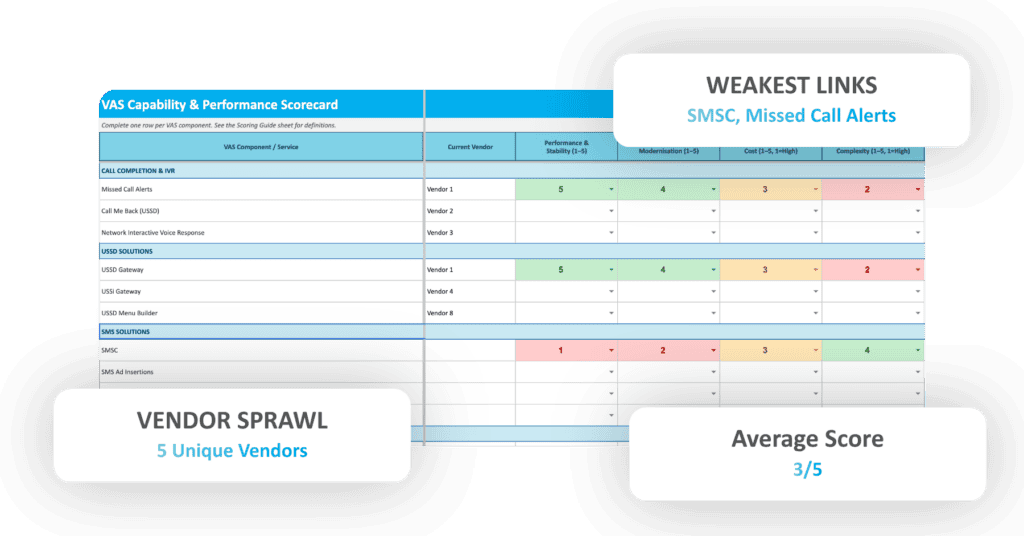
In many telecom environments, different vendors support SMS, USSD, digital services, analytics, charging support, customer engagement, and reporting, assurance, privacy, fraud, and operational control functions. Where these services involve customer engagement, subscriptions, campaigns, or personalised offers, operators may also need to govern consent records, opt-outs, privacy preferences, charging accuracy, and complaint handling across several suppliers. This often leads to multiple contracts, integrations, escalation paths, and reporting environments.
The result is compounded risk.
1. Data Silos Reduce Visibility
When data sits across separate platforms, teams struggle to maintain a full operational view.
This can lead to:
- Limited visibility across services
- Harder third party risk monitoring
- Slower access to reliable operational and customer data
- Delays in spotting problems
2. Integration Complexity Increases Exposure
Each additional interface adds another technical dependency.
This can create:
- A larger attack surface
- More configuration gaps
- Higher disruption risk
- More failure points across the service chain
3. Inconsistent Compliance Standards Weaken Control
Different vendors often follow different policies, controls, and audit practices.
This makes it harder to achieve:
- Consistent compliance evidence
- Reliable policy enforcement
- End to end traceability
- Coordinated incident response
4. Operational Dependency Becomes Harder to Govern
Critical services may depend on several external parties responding quickly and accurately.
This can lead to:
- Escalation delays
- Gaps in accountability
- Partial ownership of incidents
- Slow root cause analysis
5. Delayed Decision Making Slows Action
Teams often spend time reconciling systems and reports instead of acting on insight.
This can delay:
- Risk response
- Service recovery
- Compliance fulfilment
- Strategic decisions
The key issue is simple: vendor sprawl does not increase risk in a straight line. It compounds risk by making oversight, response, and accountability harder.
Compliance Pressure: Where Risk Becomes Liability
Vendor risk becomes more serious when it affects legal and regulatory obligations. In telecoms, compliance often depends on fast access to accurate data, clear audit trails, and coordinated execution across multiple systems and suppliers.
This creates pressure in areas such as:
- Timely regulatory reporting and response
- End to end traceability
- Audit readiness
- Secure and controlled access to operational, customer, and service data
- Consistent reporting across platforms
Fragmented vendor environments make this harder to execute. Data may sit across multiple third parties. Response times may depend on outside coordination. Audit trails may be incomplete or inconsistent.
At that point, vendor risk turns into legal exposure, regulator scrutiny, and reputational risk.
Why Traditional TPRM Platforms Fall Short
TPRM platforms, third-party risk management software, and assessment tools can help with:
- Risk scoring
- Vendor questionnaires
- Due diligence workflows
- Monitoring dashboards
- Documentation and reporting
Standards such as ISO/IEC 27001 also support stronger information security and governance. But in fragmented VAS environments, the bigger issue is often the vendor structure itself. These tools can help operators manage risk more effectively, but they do not reduce the number of vendors that need to be governed.
That is why operators should look beyond platform performance and ask whether their vendor model is creating unnecessary exposure.
The Shift: From Managing Risk to Eliminating Avoidable Risk
A stronger approach to third party risk management starts with a simple distinction. Some risk must be managed. Some risk can be designed out.
The traditional approach is to monitor more vendors more closely. A smarter approach is to reduce the number of critical vendor relationships where possible.
This aligns with GSMA’s guidance on telecom risk management, which shows that risk exposure in telecoms is shaped by architectural design, supplier selection, legacy systems, and operational arrangements.
For operators evaluating better operating models, that shift leads directly to consolidation.
VAS Consolidation as a TPRM Strategy
VAS consolidation is not only a cost decision. It is also a risk reduction strategy. The goal is not to remove all third parties or create unchecked supplier concentration. The goal is to reduce unnecessary fragmentation while maintaining strong contracts, resilience planning, exit options, performance controls, and security oversight.
A more unified environment strengthens control by creating:
- A smaller attack surface
- Better visibility across services and data
- More consistent compliance processes
- Simpler integrations
- Clearer accountability
For operators, this supports faster troubleshooting, stronger governance, easier audit preparation, and more reliable access to operational insight.

What Operators Gain From Reducing Vendor Fragmentation
Reducing vendor fragmentation can lower regulatory risk, improve compliance response times, and reduce operational complexity. It can also strengthen governance, improve audit readiness, and lower total cost of ownership. Together, these gains support both stronger risk control and better day to day performance.
A Simpler Vendor Model Creates Stronger Control
Third party vendor risk management in telecoms cannot rely only on assessments, dashboards, and monitoring tools. In fragmented VAS environments, the vendor model itself can become the risk.
For operators looking to improve control, compliance, resilience, service quality, and operational efficiency, reducing avoidable third party dependence is a practical next step. The Business Case for VAS Vendor Consolidation: A Total Cost of Ownership Framework for Telecom Operators is a useful resource for exploring how consolidation can reduce complexity and strengthen governance.

Matthew Seabrook leads the NGVAS business unit at Adapt IT Telecoms, driving next-gen telecom solutions. With 30+ years in Telecoms, ICT, and IT, his expertise in sales, operations, and professional services enables him to strategize effectively, optimise networks, and unlock new revenue. A servant leader, he fosters growth, removes obstacles, and champions innovation, ensuring lasting partnerships and a thriving, people-centric team.