
The telecommunications environment has grown increasingly complex. Many organisations manage a patchwork of value-added service (VAS) vendors, legacy systems, and new cloud environments. What initially evolved as a “best-of-breed” environment often becomes operationally fragmented over time. Different vendors introduce separate support structures, upgrade cycles, escalation paths, integration methods, and commercial models. The result is not only technical complexity, but growing operational drag that slows execution across the business. This fragmentation introduces inefficiency across operations, slowing progress and increasing costs. What once offered flexibility now limits agility and profitability.
Each additional vendor brings its own integrations, contracts, and maintenance requirements. Deployment schedules extend, support costs climb, and service uptime becomes harder to maintain. Teams spend more time coordinating vendors than improving service delivery. In many environments, operational teams are forced into multi-vendor troubleshooting cycles where no single provider owns end-to-end accountability. This increases mean time to resolution, delays deployments, and creates avoidable pressure on network, operations, and support teams. The cumulative effect is operational drag that reduces both speed and competitiveness.
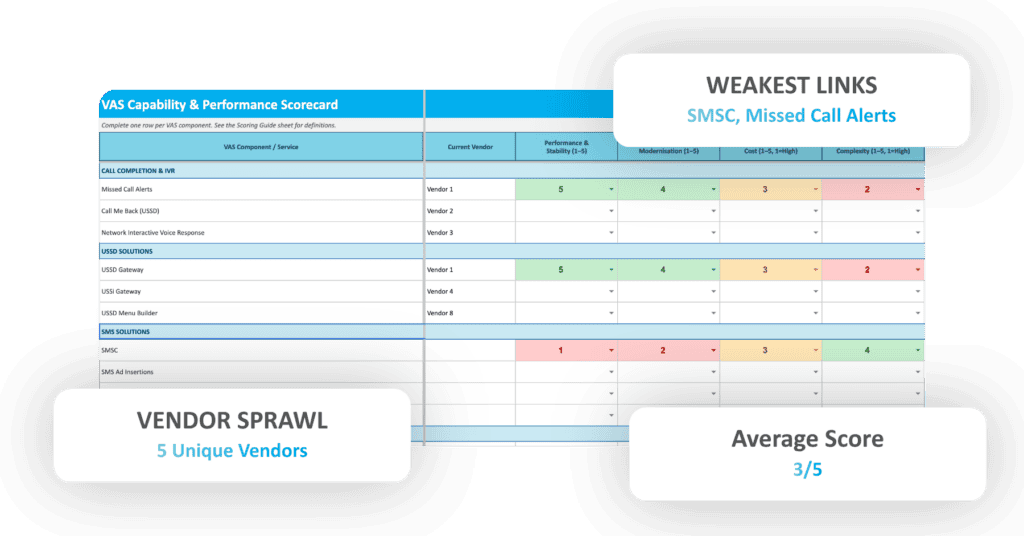
Vendor sprawl becomes more than a technical challenge, it becomes an operational and commercial constraint. As operators modernise networks, introduce digital services, and accelerate rollout expectations, fragmented VAS environments begin limiting scalability, agility, and service consistency.. Hidden costs accumulate through duplicated processes and delayed rollouts. Profit margins narrow as inefficiencies multiply. Addressing this challenge requires reframing consolidation as a business priority that drives growth, resilience, and customer trust.
Adapt IT Telecoms’ v.services environment supports full VAS Vendor Consolidation by allowing operators to deploy once and plug in multiple applications such as USSD, SMSC, and IVR within a unified platform. This approach streamlines integration, improves uptime, and accelerates time-to-market. By simplifying vendor management, it restores control and enables faster innovation.
Through this supported model, organisations can reduce complexity, strengthen governance, and position themselves to capture new opportunities with confidence.
Who Benefits from VAS Consolidation – and Where It Delivers the Most Value
Mobile VAS consolidation supports transformation for organisations navigating digital acceleration. Mobile Network Operators (MNOs), Mobile Virtual Network Enablers (MVNEs), and Mobile Virtual Network Operators (MVNOs) all operate in fast-changing environments that demand efficiency, reliability, and compliance.
Key functional areas benefit in distinct ways:
- Technology & Network Teams: Reduce integration dependency between VAS domains, simplify support structures, and improve visibility across the service environment..
- Operations Teams: Minimise vendor coordination overhead, reduce escalation complexity, and improve operational consistency and uptime..
- Finance Teams: Improve cost predictability by reducing duplicated vendor costs, support overhead, and operational inefficiencies.
- Information Systems & Transformation Teams: Enable modernisation initiatives through a scalable, modular, cloud-ready framework.
- Procurement Teams: Improve vendor accountability, simplify commercial governance, and reduce supplier management complexity.
Across all functions, shared priorities emerge: achieving predictable costs, maintaining uptime, unlocking new revenue streams, and ensuring regulatory compliance.
VAS consolidation unites these goals within a single, cohesive framework that supports long-term sustainability.
Operational Challenges and Opportunities in VAS Consolidation
Telecommunications operations are under increasing pressure to deliver consistent performance, rapid innovation, and cost efficiency. Fragmented systems and multiple vendors often create operational friction that slows progress and limits growth potential.
Network Modernisation and Digital Acceleration
Legacy infrastructure often restricts agility and limits the adoption of cloud-ready technologies. Each additional system introduces new maintenance requirements and integration points.
Consolidation provides a modern, unified environment that simplifies management and supports future digital initiatives. A consolidated platform enables faster deployment of services, improved visibility, and reduced operational overhead.
Revenue Generation and Monetisation
Unified platforms shorten deployment cycles and support faster rollout of new services. This acceleration enables organisations to capture market opportunities, introduce innovative offerings, and expand customer value.
Time to Market
Speed of execution is a decisive factor. When multiple vendors and integration layers are involved, new services can take months to launch. Through a unified VAS environment, deployment processes are standardised, reducing rollout times and enabling rapid response to market trends. This agility supports faster revenue capture and improved competitive positioning.
In fragmented environments, even relatively simple service launches can require coordination across multiple vendors, testing teams, integration layers, and approval cycles. This slows rollout velocity and limits the operator’s ability to respond quickly to commercial opportunities or competitive market changes.
Cost Optimisation
Hidden costs often accumulate within multi-vendor ecosystems. Each vendor introduces its own support, licensing, and upgrade cycles. Consolidation eliminates duplication and reduces the administrative burden associated with vendor coordination. The result is a more predictable cost structure that supports long-term financial stability.
Vendor Stability and Uptime
Reliability is central to operational success. Disparate systems increase the risk of downtime and service interruption. A centralised architecture supported by a single, accountable partner enhances uptime and reduces dependency on multiple service-level agreements. This structure provides a clear line of responsibility for performance and maintenance.
Where multiple vendors operate independently across interconnected services, root-cause analysis often becomes fragmented. Support teams may spend hours or days coordinating between vendors before accountability is established, increasing operational pressure and prolonging service impact.
AI-Enabled Efficiency
Automation is now essential to managing complex telecom environments. Through a consolidated platform, AI can be applied to provisioning, monitoring, and optimisation processes. This creates a consistent operational rhythm that improves efficiency and frees technical teams to focus on innovation and service quality.
Customer Experience and Churn
Customers expect uninterrupted service and seamless engagement. Fragmented networks often create inconsistencies that lead to dissatisfaction and churn. A consolidated system ensures uniform performance and service quality across all channels, strengthening loyalty and brand reputation.
Compliance and Governance
Regulatory compliance remains a critical responsibility for operators. Managing multiple vendors complicates audit processes and increases risk exposure. Centralised oversight simplifies compliance reporting, enhances transparency, and supports stronger governance.
As regulatory requirements continue evolving across African and international telecom markets, fragmented reporting and inconsistent governance structures increase audit complexity and operational exposure.
By addressing these challenges through VAS consolidation, you can transform operations into a foundation for growth and resilience.
Financial Insights and Cost Drivers
Value-added service (VAS) consolidation represents an opportunity to establish financial predictability and long-term efficiency. The goal is to manage spending effectively while ensuring that every investment delivers measurable value across the organisation.
1. Direct and Hidden Costs
Telecommunications operations often include a blend of visible and concealed expenses.
- Direct costs include licensing, infrastructure, and vendor support fees.
- Hidden costs arise from integration delays, unplanned downtime, and duplicated maintenance across multiple systems.
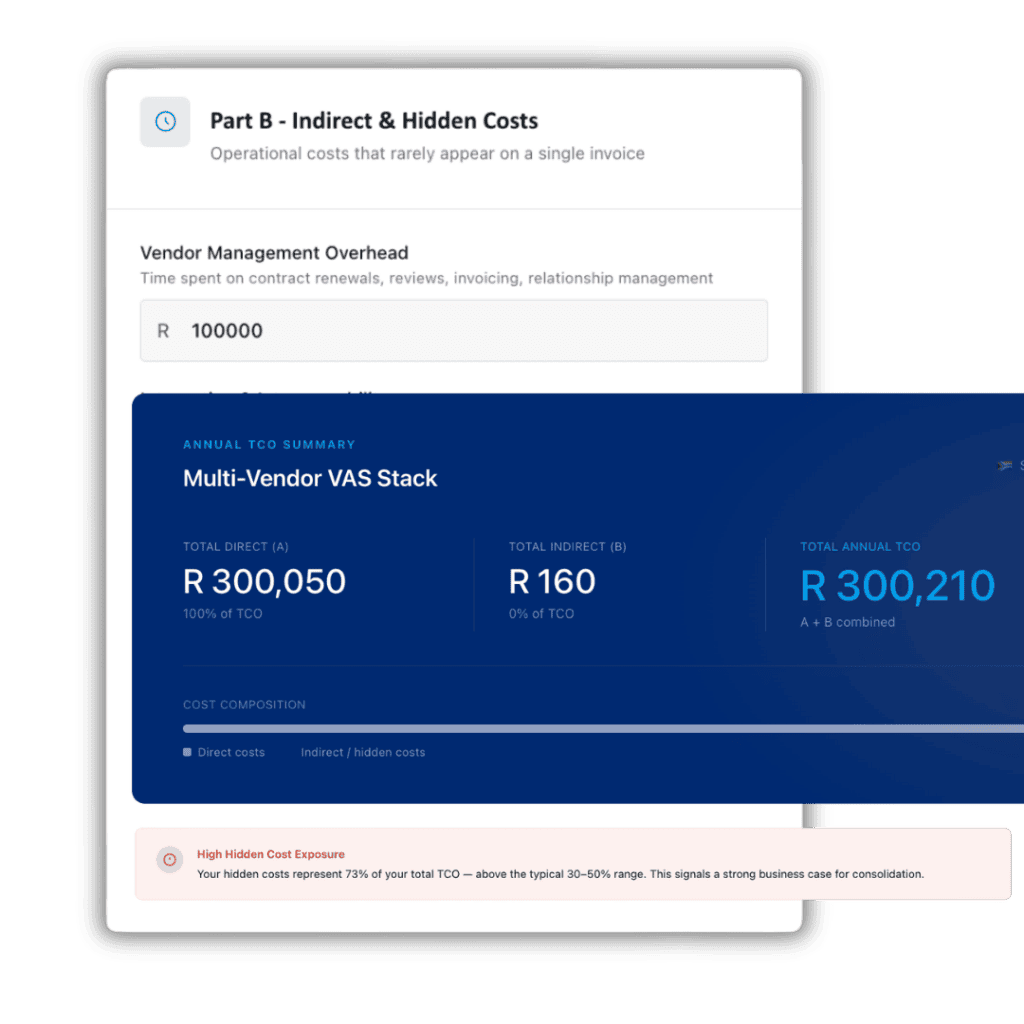
- Many of these costs do not appear within a single budget line. Instead, they accumulate across operations, infrastructure, vendor management, support, integration, and delayed revenue opportunities, making the true cost of fragmentation difficult to quantify internally.
- Each additional vendor introduces complexity that erodes profitability through inefficiencies in management and reporting.
A consolidated platform simplifies financial tracking by uniting multiple service functions under one accountable structure. This approach reduces operational waste and supports transparent budgeting.
| Direct Costs | Hidden Costs |
| Licensing fees | Integration delays |
| Infrastructure setup and maintenance | Downtime and service disruptions |
| Vendor support contracts | Duplicated maintenance efforts |
| Software upgrades and renewals | Manual reporting and reconciliation |
| Hardware and hosting | Lost revenue from delayed rollouts |
Access the Total cost of Ownership Evaluator Here
2. Operational Cost Categories Often Overlooked
Operators evaluating consolidation initiatives should also consider operational costs that are frequently underestimated within fragmented environments:
- Vendor coordination overhead
- Parallel support and maintenance contracts
- Delayed rollout and testing cycles
- Repeated integration and customisation work
- Inconsistent monitoring and observability
- Escalation management across multiple suppliers
- Infrastructure duplication
- Rollback and release management complexity
3. Financial Evaluation Framework
To evaluate the financial impact of consolidation, a structured framework is required that measures both immediate and long-term benefits.
- Return on Investment (ROI): Assess savings from reduced vendor contracts, lower maintenance costs, and faster service rollouts.
- Total Cost of Ownership (TCO): Examine the full lifecycle costs of current systems, including integration, training, and support.
- Long-term Value: Consider improved uptime, fewer service disruptions, and enhanced scalability that reduce cost exposure over time.
This evaluation provides a clear financial case for consolidation as a sustainable business strategy.
4. Predictable Scaling
As subscriber bases grow, operational costs can increase unpredictably. A unified VAS environment creates a foundation for scaling with control.
- Capacity can expand without the need for new vendor negotiations or complex integration projects.
- Financial forecasting becomes more accurate as costs align with usage and performance metrics.
- Procurement teams gain improved oversight of expenditure, ensuring accountability and compliance with contractual terms.
VAS consolidation is a financial enabler. It delivers cost visibility, operational resilience, and measurable returns.
To identify hidden cost drivers, you can access the Total Cost of Ownership Evaluator here.
Key Technical Challenges and Solutions
Telecommunications environments require agility, visibility, and consistency across all value-added services. Many current systems have grown through incremental integrations that now limit flexibility.
The focus is shifting from managing complexity to building unified, cloud-ready environments that support scalable, efficient operations.
1. Architectural Simplification
Reducing layers of integration and consolidating service functions under a unified environment improves maintainability and accelerates innovation.
2. Deployment Agility
Deployment agility becomes increasingly difficult in environments where multiple vendors, integration layers, and operational dependencies must align before services can go live. Standardised deployment models and pre-integrated modules reduce rollout complexity and improve execution speed..
3. Reliability and Performance Stability
Fragmented VAS environments increase the number of potential failure points across the service chain. Centralised monitoring, unified operational ownership, and standardised support processes improve stability and reduce dependency on cross-vendor escalation cycles.
4. Cloud Enablement and Scalability
Flexible deployment models, including hybrid and full cloud options, allow seamless scaling and adaptation to evolving network demands.
5. Security and Compliance Alignment
Consolidated governance frameworks simplify compliance reporting and strengthen data integrity across all service layers.
6. Data-Driven Control
End-to-end visibility provides actionable insights into performance, enabling continuous optimisation and informed decision-making.
These priorities form the foundation for the next stage of transformation.
The v.services Framework Solution
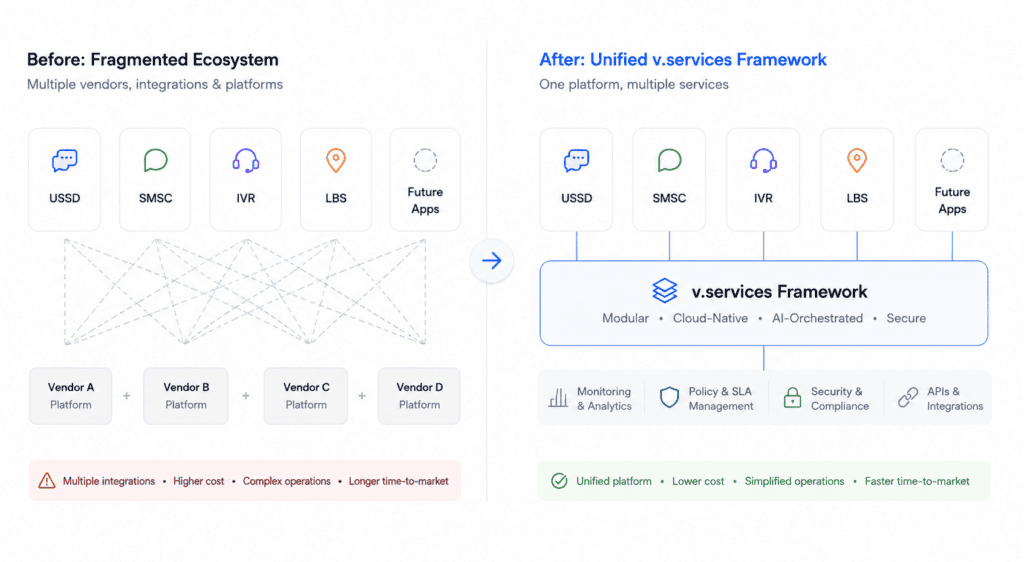
Adapt IT Telecoms’ v.services Framework provides a unified foundation that replaces fragmented systems by allowing operators to deploy once and plug in multiple applications such as USSD, SMSC, and IVR. With a structured, modular architecture. It is designed to simplify operations, enhance control, and improve overall performance.
The v.services Framework is designed around a “deploy once, expand progressively” model.
Rather than deploying separate infrastructure and integration layers for each VAS application, operators establish a unified service framework that supports the onboarding of additional services over time.
This allows operators to:
- Reduce repeated deployment cycles
- Standardise integration methods
- Simplify operational management
- Accelerate onboarding of new VAS services
- Reduce future migration complexity
- Create a scalable foundation for modernization
Services such as USSD, SMSC, IVR, LBS, and future applications can then be introduced progressively within the same operational framework rather than through separate vendor ecosystems.
Key features include:
- Network Modernisation: The framework is cloud-native and modular, enabling scalability and seamless integration into existing environments.
- Digital Acceleration: AI-driven orchestration automates routine processes such as provisioning, scaling, and monitoring.
- Full-Stack Integration: Core telecom applications such as USSD, SMSC, IVR, and Location-Based Services (LBS) are consolidated within a single ecosystem.
- Deployment Speed: Pre-integrated modules allow faster implementation and reduce dependency on multiple third parties.
- Stability: Centralised SLAs create consistent performance standards and minimise service interruptions.
- Cost Efficiency: Eliminating redundant systems and processes reduces operational overhead and simplifies maintenance.
- Compliance: Centralised monitoring and reporting ensure that regulations are met efficiently and transparently.
- Revenue Enablement: A unified environment supports faster rollout of new, monetisable services and allows for quicker adaptation to market demands.
For a detailed overview of the v.services Framework and its role in enabling unified VAS environments, download the v.services Framework whitepaper.
Strategic Outcomes
Implementing a unified VAS environment transforms how technology teams operate.
- IT departments gain a single control point for service management.
- System performance becomes predictable through centralised oversight.
- Collaboration between technical and business functions improves as data and reporting become more consistent.
- The organisation is positioned for sustainable growth through a flexible, cloud-ready infrastructure.
For those seeking to assess potential partners and frameworks, Adapt IT Telecoms provides the Unified VAS Platform Vendor Evaluation Checklist, a practical guide to identify the right path toward technical efficiency and long-term reliability.

The Options Explained
Telecommunications leaders evaluating VAS consolidation have several strategic paths available. Each option carries distinct benefits and considerations. The right choice depends on organisational priorities, readiness, and long-term transformation goals.
Option A: Multi-Vendor Continuation
Many operators continue to operate within multi-vendor environments. This approach maintains existing systems and relationships but introduces ongoing inefficiencies.
While many operators continue operating within multi-vendor VAS environments, long-term operational complexity typically increases as new services, integrations, and modernisation requirements are introduced.
Trade-offs:
- Hidden Costs: Multiple licensing fees, support contracts, and integration expenses accumulate over time.
- Operational Drag: Coordinating vendors slows deployment and limits responsiveness to market demands.
- Inconsistent Performance: Different service-level standards lead to unpredictable uptime and quality.
- Higher Risk Exposure: Security, compliance, and accountability gaps increase as systems remain fragmented.
- Extended Root-Cause Analysis: Multi-vendor environments often increase troubleshooting complexity during outages and service degradation incidents.
- Conflicting Upgrade Cycles: Independent vendor release schedules can create interoperability risks and deployment delays.
- Inconsistent Operational Tooling: Different monitoring, reporting, and management tools reduce operational visibility across the environment.
- Rollback Complexity: Coordinating rollback procedures across multiple vendors increases operational risk during deployments.
- Fragmented Accountability: Service-impacting incidents can result in delayed resolution where ownership is spread across multiple suppliers.
While maintaining the status quo may appear convenient, it restricts agility and limits future scalability.
Option B: Full Consolidation (Next Generation VAS)
A full consolidation strategy replaces multiple platforms with a unified, centralised VAS environment. This approach aligns technology, operations, and financial efficiency under a single framework.
Differentiators:
- Deep local telecommunications expertise, particularly across African markets.
- Supported by the Adapt IT Group and Volaris, providing stability and long-term commitment.
- Cost-efficient structure that supports regional and global expansion.
- Dedicated support teams that ensure continuity and adaptability.
- Fully customisable and scalable architecture designed to meet specific operator needs.
- Simplified vendor management with a single point of accountability.
Trade-offs:
- Requires an initial migration phase that demands planning and resource allocation.
- Creates dependency on a primary vendor for ongoing support and system evolution.
Despite these trade-offs, full consolidation offers the strongest route to achieving operational efficiency and financial predictability.
Option C: Phased or Hybrid Consolidation
Some organisations prefer a gradual approach that balances risk and progress. This method introduces consolidation by service category, beginning with high-impact areas such as USSD or SMSC.
Approach:
- Step-by-step migration allows testing and validation before full adoption.
- Internal teams adapt gradually to new systems and workflows.
v.services Advantage:
- The framework-first strategy ensures that each phase integrates seamlessly into future deployments.
- Provides flexibility for operators managing diverse service portfolios.
Trade-offs:
- Return on investment may take longer to realise.
- Success depends on maintaining a disciplined roadmap and governance model.
Selecting the right path requires clarity on strategic priorities, risk tolerance, and operational maturity. Each option provides a foundation for transformation, but the value lies in structured execution and informed decision-making.
Managing Migration Risk During Consolidation
One of the primary concerns operators face during consolidation initiatives is migration risk. Concerns around downtime, rollback exposure, operational disruption, and service continuity often delay modernisation decisions.
Successful VAS consolidation programmes typically follow a phased and controlled migration model rather than a “big bang” replacement approach.
Typical Risk Mitigation Approaches Include:
- Prioritising lower-risk or high-impact services first
- Running parallel environments during transition phases
- Establishing rollback procedures and validation checkpoints
- Aligning migration windows with operational readiness
- Performing staged integration and interoperability testing
- Implementing clear governance and escalation structures
This phased approach allows operators to modernise progressively while maintaining operational continuity and reducing service risk.
Costs, Timelines, and Implementation Factors
Planning a VAS consolidation project requires a clear understanding of the factors that influence investment levels and project duration. Costs depend on transaction volumes, technical complexity, deployment preferences, and contractual terms.
Cost Drivers (Up)
Certain conditions increase the overall cost of implementation.
- High Transaction Volumes: Larger subscriber bases or data traffic require more robust infrastructure and capacity.
- Complex Integrations: Multiple legacy systems and third-party connections raise development and testing requirements.
- On-Premise Deployments: Physical infrastructure and maintenance introduce higher setup and operational costs.
- Tight SLAs: Demanding service-level agreements may require additional redundancy and support capacity.
Cost Drivers (Down)
Other factors help reduce costs and improve long-term affordability.
- Standard Deployments: Adopting pre-configured modules shortens build time and limits customisation costs.
- Lower Subscriber Tiers: Smaller user bases reduce hardware and capacity expenses.
- Longer Contract Terms: Multi-year agreements often provide cost stability and improved pricing structures.
Implementation Phases
A structured rollout ensures efficiency and accountability at each stage.
- Discovery: Assess current systems, integrations, and business needs.
- Deployment: Install and configure the unified VAS platform.
- Testing: Validate performance, security, and compatibility.
- Go-Live: Launch production operations with monitoring in place.
- Optimisation: Fine-tune performance and integrate feedback from operations teams.
Typical Timeline
Implementation timelines vary significantly depending on the number of services being consolidated, the complexity of existing integrations, operational readiness, deployment model preferences, and migration sequencing requirements.
For many operators, phased consolidation programmes may run over several months as services are progressively migrated and validated.
Negotiables and Fixed Elements
- Negotiable: Contract terms, SLAs, and feature development roadmaps may be tailored to operational priorities.
- Fixed: Core platform pricing and compliance-related costs remain consistent to ensure transparency and alignment with regulations.
A clear understanding of these factors helps organisations plan budgets, allocate resources, and manage expectations effectively.
Risk Considerations and Mitigation Measures
A structured approach to supplier selection, contracting, and performance management ensures that the organisation maintains control throughout each stage of implementation.
Key Risk Areas and Mitigation Measures
Vendor Lock-In
Vendor dependency is a common concern during consolidation. This can be mitigated by:
- Including exit clauses that define clear terms for contract termination and data portability.
- Structuring modular agreements that allow independent deployment or replacement of specific services without disrupting the entire platform.
- Operators should also assess roadmap transparency, interoperability standards, and the vendor’s ability to support phased or modular deployments over time.
Migration Risk
Transitioning from multiple systems to a unified platform requires careful coordination.
- Adopt a phased rollout approach that allows for incremental testing and validation.
- Establish uptime accountability through detailed service-level commitments and performance tracking.
- Procurement and operations teams should ensure migration accountability, rollback planning, and testing methodologies are formally documented prior to implementation.
Feature Parity
Maintaining functionality throughout the migration process is essential to operational continuity.
- Confirm that the vendor provides a documented product roadmap outlining feature availability and delivery timelines.
- Secure contractual guarantees to ensure that all existing service capabilities are maintained or improved after consolidation.
Compliance Risk
Regulatory adherence must remain consistent during and after the transition.
- Include audit rights within vendor contracts to ensure transparency in operations and data handling.
- Require regular compliance reporting to validate that all industry and regional standards are met.
By addressing these risks through proactive governance and contractual safeguards, organisations can protect their interests and ensure the long-term success of VAS consolidation.
Operational and Business Benefits of VAS Consolidation
An operator implementing Adapt IT Telecoms’ Next Generation VAS can apply the platform to streamline and unify all value‑added service functions within a single environment. It becomes the central hub for managing USSD, SMSC, IVR, and other key applications, creating a more cohesive and efficient operating model.
By using Adapt IT Telecoms’ Next Generation VAS in this way, organisations can:
- Accelerate Service Rollout: Standardised deployment models, pre-integrated modules, and reduced cross-vendor coordination requirements.
- Reduce Operational Expenditure: Lower ongoing costs through a single management structure that eliminates overlapping vendor contracts and maintenance activities.
- Increase Uptime: Maintain consistent service availability through unified monitoring and automated fault detection.
- Minimise Support Overhead: Use integrated reporting and diagnostics to reduce support tickets and improve response times.
- Operational Visibility & Support Simplification: For operators managing multiple VAS domains, consolidation improves operational visibility and simplifies long-term support management by reducing fragmented ownership structures.
- Enhance Customer Experience: Deliver uniform service quality, which improves customer satisfaction and creates new monetisation opportunities.
This demonstrates how VAS consolidation supports both operational and strategic objectives. It enables organisations to modernise their environments, strengthen governance, and achieve financial stability while improving service delivery.
Take Your Next Step with VAS Consolidation
VAS consolidation enables telecom operators to achieve operational efficiency and sustainable growth. By unifying systems and streamlining vendor management, organisations reduce complexity, enhance agility, and improve financial performance. A consolidated environment supports faster service delivery, stronger governance, and consistent customer experiences.
For operators under pressure to modernise networks, accelerate rollout timelines, improve uptime, and manage operational costs more effectively, VAS consolidation provides a structured path toward operational simplification and long-term scalability.
You can also book a consultation with Adapt IT Telecoms experts to discuss your organisation’s specific goals and implementation roadmap.