
Telecom migration is a necessary step for operators modernising billing, VAS, Cloud, policy, and customer-facing systems. But many migration programmes do not fail outright. They stall. Timelines slip, costs rise, cutovers get delayed, and temporary dual-running becomes difficult to end. This is especially common where billing, charging, mediation, VAS, CRM, partner management, and reporting systems have been extended over many years without a single architecture baseline.
In many cases, the issue is not effort, intent or project discipline. It is unresolved architectural complexity in the environment being migrated. Before refining the migration plan, operators often need to simplify the environment first.

The Reality of Legacy Telecom Environments
Most legacy telecom estates are not built around a single outdated platform. They are usually the result of years of expansion, urgent fixes, vendor additions, and operational workarounds.
A typical environment may include:
- Multiple billing systems introduced at different stages of growth
- Disconnected VAS platforms from several vendors
- Legacy mediation layers linking old and newer systems
- Custom integrations developed to solve immediate business needs
Over time, this creates an environment that is difficult to fully understand or manage.
Why Visibility Breaks Down
Ownership is often spread across teams. Documentation may be outdated, inconsistent, or incomplete. Critical business logic can sit inside aging workflows that no one wants to disturb close to a migration event. As a result, operators are rarely migrating from a clean baseline. More often, they are migrating from a patchwork of systems that were never designed to function as one unified architecture.
This is important because fragmented environments are more difficult to test, more difficult to sequence, and more difficult to predict. The more fragmented the estate becomes, the harder it is to forecast migration outcomes with confidence.
Why Migration Complexity Keeps Increasing
Migration complexity rarely stays static. In most telecom environments, it grows over time, even while modernisation is already underway.
Cloud migration for telecom does not automatically reduce this complexity. In many cases, cloud migration simply exposes hidden dependencies, inconsistent data flows, and unclear ownership faster.. As new platforms are introduced before legacy ones are rationalised, the number of dependencies increases. More dependencies create more points of failure, and more failure points make testing and cutovers less predictable.
When Modernisation Adds Another Layer
Partial modernisation can make this worse. Legacy and modern systems often need to run together for longer than expected. Data flows become split across environments. Service logic may end up duplicated between platforms. Teams then have to manage both transformation and coexistence at the same time. This can increase operational workload, testing scope, incident risk, and the cost of keeping legacy skills available while the new environment stabilises.
This is why some telecom migration solutions appear to advance a programme without actually reducing its underlying risk. They add a new layer to the architecture without removing enough of the old one. Without simplification, modernisation can reinforce the very complexity it was meant to solve.
The Hidden Cause Is Fragmented VAS Ecosystems
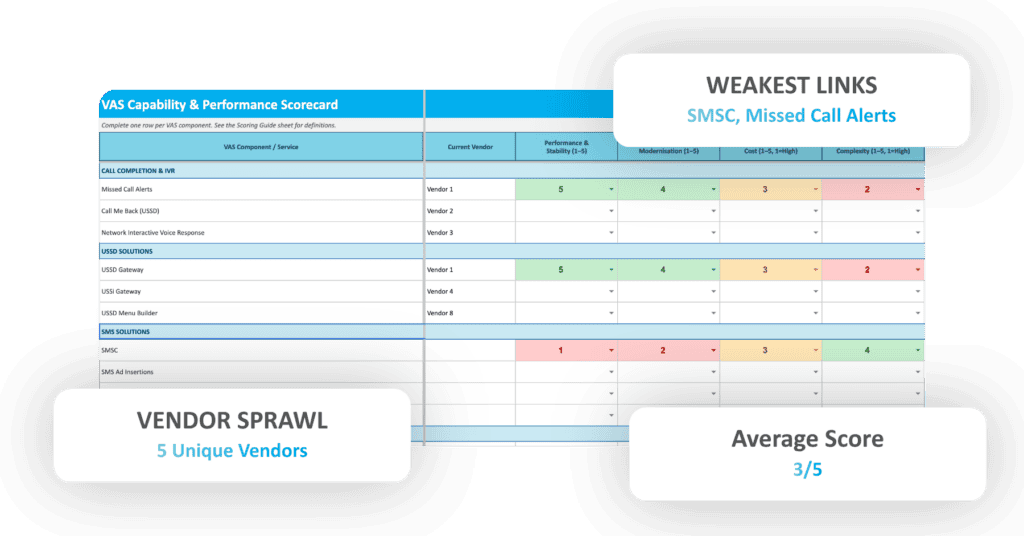
In many telecom environments, VAS sprawl is one of the main reasons migration becomes difficult to execute. It is often underestimated because each platform may appear manageable in isolation. The challenge emerges when all of those systems must be migrated, integrated, tested, and cut over as part of one broader programme.
Fragmented VAS ecosystems include:
- Multiple messaging platforms
- Separate USSD environments
- Subscription and content-service engines
- Campaign and customer-engagement platforms
- Charging, rating, and balance-check integrations
- Partner portals and reporting tools
- Different service engines
- Vendor-specific APIs and Middleware
- Duplicated service logic across channels
Where The Risk Shows Up
While these systems may support daily operations, they introduce structural complexity into migration. The effects are practical and immediate:
- Data becomes inconsistent across platforms
- Integrations begin to conflict
- Ownership of service behaviour becomes unclear
- Cutover behaviour becomes harder to predict
This creates risk well beyond the technical layer. The more fragmented the VAS stack becomes, the more difficult it is to migrate telecom partner data, service rules, and customer interactions cleanly.
A dependency that feels manageable during normal operations can become a blocker during migration. That is why VAS fragmentation should be treated as a structural issue, not a minor technical inconvenience.
Why Telecom Migration Planning Often Fails
Planning is still essential. The problem is not planning itself. The problem is that planning becomes unreliable when the architecture underneath it is unstable.
Even experienced teams and telecom migration planning services can struggle in highly fragmented environments because the baseline is unclear. Four common issues include:
- Incomplete dependency mapping
- Vendor systems behaving differently under production load
- Inconsistent data models across platforms
- No unified architecture baseline to plan against
This uncertainty affects every phase of execution. As complexity remains in place:
- Testing expands because exceptions multiply
- Rollback scenarios become more complex
- Timelines lose credibility
- Migration plans need repeated revision
Planning works best when the operating environment has already been simplified to a manageable level. Where fragmentation remains high, planning often describes an intended route rather than a dependable one. That is why telecom migration planning cannot carry the full burden alone.
Migration Stalls When Nothing Is Simplified First
Migration does not usually need more planning first. It needs less complexity first.
When programmes stall, it is often because teams are trying to move an environment that is too fragmented to move cleanly. Before large-scale migration begins, operators need to:
- Reduce duplication
- Rationalise integrations
- Establish clearer ownership across systems
This is often the difference between a migration that keeps slipping and one that can move forward with greater control.
What Operators Should Fix First
Operators should start with the areas that create the most migration uncertainty: duplicated VAS platforms, undocumented integrations, inconsistent service logic, unclear system ownership, poor data quality, and vendor dependencies that affect cutover readiness. Fixing these areas first creates a cleaner baseline for planning, testing, rollback design, and phased execution.
How VAS Consolidation Helps Unblock Stalled Migration
VAS consolidation offers a practical way to reduce complexity before migration execution begins. Consolidation should still be planned carefully. Operators need to avoid creating new concentration risk, weakening resilience, or moving too much service logic into a single platform without clear controls, exit options, and performance safeguards. Instead of carrying multiple disconnected service environments into the next phase of transformation, operators can simplify the architecture first.
By consolidating VAS layers, organisations can:
- Reduce the number of systems being migrated
- Standardise integration points
- Simplify data structures
- Remove redundant vendor dependencies
This is where a unified service framework becomes important. Replacing disjointed platforms with a more manageable environment can reduce operational burden before the migration programme accelerates. For operators reviewing telecom migration solutions, this creates a more practical path to lowering risk.
How Consolidation Improves Migration Execution
Once VAS complexity is reduced, migration execution becomes more predictable.
The practical impact includes:
- Faster testing cycles because there are fewer moving parts
- Fewer integration failures across systems
- Cleaner telecom data migration paths
- More predictable cutover timelines
Consolidation also improves operational readiness. Teams can:
- Assign ownership more clearly
- Validate data more easily
- Control migration sequencing with more confidence
As a result, migration plans become more realistic because they are built on a simpler and more stable baseline.
Improving Telecom Migration Outcomes
Migration outcomes improve when architecture is simplified first.
Better preparation means:
- Fewer platforms
- Cleaner interfaces
- More consistent data
- Stronger visibility across dependencies
This applies across several migration scenarios, including telecom billing data migration, telecom cloud migration, database migration for telecom, and telecom legacy system migration.
The relationship is straightforward. Cleaner architecture improves predictability. Better predictability improves execution. Better execution improves business outcomes.
For operators assessing telecom migration consulting services or internal transformation priorities, this is a useful shift in perspective. Migration success depends on reducing avoidable complexity before execution begins.
The Business Impact
When avoidable complexity is reduced early, the business value becomes easier to measure.
Operators can benefit from:
- Reduced programme delays
- Lower migration cost overruns
- Faster time to value
- Reduced operational risk
- Higher cutover success rates
These improvements do not come from better reporting alone. They come from making the environment easier to migrate in the first place. This is closely aligned with the wider business case for legacy network rationalisation, where reducing avoidable complexity can improve both cost control and long-term transformation readiness.
Migration success is not only a technical outcome. It influences cost control, service continuity, and confidence in future transformation work. Operators that simplify first are often better positioned for what comes next because they are building on a cleaner operational foundation.

A Smarter Starting Point for Migration Readiness
For operators reviewing telecom migration planning services or broader telecom migration options, the next step is often to assess how much vendor and platform sprawl exists inside the VAS estate.
Exploring the role of VAS vendor consolidation can help operators identify where complexity, cost, and migration risk can be reduced before major execution begins. For a deeper commercial view, read The Business Case for VAS Vendor Consolidation: A TCO Framework for MNOs, which offers a practical view of the operational and cost case for simplifying before migrating.

Matthew Seabrook leads the NGVAS business unit at Adapt IT Telecoms, driving next-gen telecom solutions. With 30+ years in Telecoms, ICT, and IT, his expertise in sales, operations, and professional services enables him to strategize effectively, optimise networks, and unlock new revenue. A servant leader, he fosters growth, removes obstacles, and champions innovation, ensuring lasting partnerships and a thriving, people-centric team.