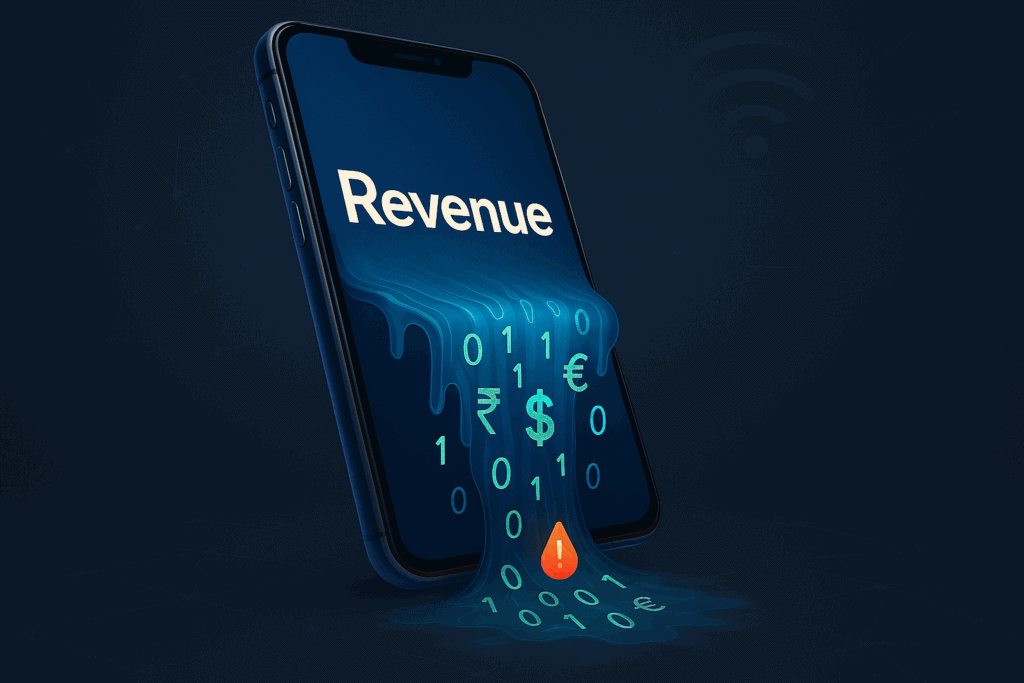
Revenue leakage quietly drains profits from telecom companies. It’s not one big failure, it’s a steady loss caused by small errors across complex systems. These leaks, driven by factors such as billing errors, process gaps, unbilled services as well as product revenue cannibalism due to inefficient product pricing, add to the industry’s yearly financial losses. According to the Communications Fraud Control Association (CFCA), global telecom operators lost an estimated US $38.95 billion in 2023 to fraud and related revenue leakage, equivalent to around 2.5% of total industry revenues.
As telecom services move to the cloud, they depend on many different systems and vendors. Each link adds another possible failure point. Traditional, manual assurance methods are no longer sufficient to navigate this new landscape. The demand for smarter, proactive solutions is growing fast. Analysts expect the global revenue assurance market expected to grow from $0.8 billion in 2025 to $1.7 billion by 2035. This isn’t just about plugging holes; it’s about building a resilient financial foundation for the future of connectivity.

Defining Revenue Leakage and Its Impact
Revenue leakage is the gap between the revenue you should have earned and what you actually collected. It’s the money that falls through the cracks due to failures in your data, processes, or systems. The impact is direct, it cuts profits, distorts forecasts, and forces teams to fix problems instead of focusing on growth.
The operational impact is just as severe, leading to inefficiency and data mistrust between departments. Perhaps most importantly, it damages customer trust. An enterprise client who discovers they’ve been overbilled on a complex SLA or a subscriber who is incorrectly charged for data will question the integrity of your entire service.
Real-world examples of revenue leakage:
In Telecom
A Mobile Network Operator (MNO) launches a new 5G data bundle. However, a misconfiguration between the billing system (from Vendor A) and the network policy controller (from Vendor B) means that 5% of users aren’t charged for usage. The leak is small on a per-user basis but scales to millions in lost revenue over a quarter.
In Enterprise
A SaaS company fails to automatically bill for a contract renewal because its CRM and billing platforms aren’t properly integrated. The client keeps using the service for three months until the error is found. Collecting payment becomes difficult, and the relationship suffers.
Common Causes of Revenue Leakage
While the modern telecom environment introduces new complexities, the root causes of revenue leakage often fall into five key categories. Understanding these culprits is the first step toward revenue leakage prevention.
Top Culprits
- Billing Errors: Inaccurate invoices, unrated CDRs, or system failures between network and billing.
- Pricing Inconsistencies: Wrong discounts or tariff plans that cause under‑billing.
- Contract Mismanagement: Unbilled renewals or missed SLA penalties cause revenue gaps.
- Process Inefficiencies: Manual reconciliations often create human errors.
- Uncollected Payments / Over-Discounting: Unpaid debts and fraudulent discounts reduce profit.
Top Leakage Drivers MNOs Face
For Mobile Network Operators,these problems show up in familiar, measurable ways. The table below highlights the most common issues.
Challenge | MNO Impact |
Billing and Rating Errors | Unrated CDRs, missed SMS/voice/data events, failed mediation between network nodes and billing, product revenue cannibalism. |
Tariff Configuration Gaps | Incorrect bundle rules, miscalculated roaming tariffs, faulty partner pricing for wholesale services. |
Contract and SLA Misalignment | Unbilled enterprise contracts, wholesale interconnect mischarges, and missed revenue from MVNO partners. |
Manual Processes | Time-consuming reconciliations relying on spreadsheets and human checks, which fail to keep pace with data volume. |
Uncollected / Discount Leakage | Fraudulent discounts, unpaid interconnect debts, and widespread misuse of promotional bundles. |
The Cloud Era Challenge: Multi-Vendor Complexity
The shift to hybrid and cloud-based systems has fundamentally changed the game for revenue assurance. In the past, assurance teams dealt with a relatively contained, on-premise ecosystem. Today, data flows across a distributed network of private clouds, public cloud platforms like AWS, and dozens of third-party vendor solutions.
This complexity breaks traditional assurance systems. They were never designed to reconcile data across so many disparate sources in real-time. One customer transaction can pass through several vendors—core network, billing app, and third‑party API—before completion. Without a single view of data, operators can’t be sure every transaction is captured and billed correctly.
This is where the need for near real-time visibility and unified data governance becomes important. You can’t control what you can’t see. To prevent revenue leakage in the cloud era, you need a solution that can ingest, normalise, and analyse data from every corner of your ecosystem, regardless of the vendor or platform.
How AI and Automation Transform Revenue Assurance
Modern telecom data moves too fast for manual checks. Automated, AI‑driven tools handle the scale far better than traditional audits. According to TM Forum’s Revenue Assurance Survey Report, the average revenue recovery rate among operators is only 51%, even with a 10% improvement over previous years. In other words, nearly half of all leaked revenue remains unrecovered when traditional methods are used. A proactive, AI‑driven assurance approach can:
- Reconcile Data Automatically: Match billions of records in minutes and flag mismatches right away.
- Detect Anomalies with Machine Learning: Identify subtle billing or usage patterns that point to potential leaks.
- Audit Continuously: Run automatic system checks that reduce human error and highlight systemic issues early.
These benefits extend far beyond telecom. In the energy and utilities sector, these same principles are used to ensure smart meter accuracy and detect consumption anomalies. The core value is universal: using intelligent automation to ensure every transaction is accounted for accurately.
Adapt IT Telecoms’ Solution: CDRlive Revenue Assurance
In today’s multi‑vendor cloud environment, operators need more than a tool—they need one intelligent hub for revenue assurance. This is precisely why we developed CDRlive, our enterprise-grade data warehouse and analytics platform. It was engineered specifically to provide a single source of truth for complex telecom environments.
CDRlive isn’t just another data lake. It’s a purpose-built solution that provides end-to-end visibility and control over your revenue streams.
Key Capabilities
- Near Real‑Time Data Reconciliation: Combine data from all sources for a single, live view of every transaction.
- Tariff Error Detection: Instantly spot billing or pricing mismatches, including roaming and bundle issues.
- Automated Monitoring and Alerts: Track revenue patterns continuously and get instant alerts on new leaks.
- Audit‑Ready Compliance: Maintain a fully reconciled data warehouse that meets all regulatory standards.
Critically, CDRlive is designed to bridge the old and the new. Its features seamlessly support both legacy systems and modern cloud platforms. This gives you a clear path to future-proof your operations as your network continues to evolve.
Read: Revenue Assurance and Fraud Management System Case Study
Cross-Industry Insight: Preventing Revenue Leakage Beyond Telecom
The same principles behind strong revenue assurance apply to many other industries facing high‑volume transactions.
- Energy and Utilities: Our approach to analysing event data can be applied to prevent revenue leakage from smart meter inaccuracies. It can also identify consumption anomalies indicating grid issues, or even detect electricity tampering.
- Financial Services: For banks and FinTech companies, this technology can ensure compliance with complex fee structures, reconcile transactions across payment gateways, and identify unauthorised transactions.
- Government Billing: Public sector organisations can use these analytics and automation principles to improve accuracy and control over billing for utilities, taxes, and other public services. This ensures fairness and financial integrity.
This cross-industry applicability demonstrates the power of a foundational, data-driven approach to revenue assurance.
Steps to Prevent Revenue Leakage
Securing your revenue streams requires a strategic, holistic approach. Here is a practical checklist to guide your efforts and establish robust revenue leakage control.
Practical Checklist
- Audit Regularly: Replace annual checks with continuous, data‑driven reviews.
- Automate Systems: Reduce human errors in billing and contracts.
- Track Key Metrics: Monitor ARPU, ASPU, and churn for unusual changes.
- Unify Data: Integrate finance, sales, and operations into one view.
- Adopt AI Tools: Use automation to detect problems early and recover lost revenue.
Securing the Future of Revenue Assurance
Revenue leakage is serious, but it can be stopped. With the right technology and strategy, telecom operators can prevent most losses. As the industry grows more complex and data‑heavy, manual methods simply can’t keep up.
Don’t let silent leaks drain your bottom line. Explore how AI-driven assurance technologies like CDRlive can help you prevent revenue leakage, strengthen governance, and unlock new levels of profitability. Get in touch with our experts to see how a unified data approach can secure your business for the future.
Explore the Power of CDR
Download your free white paper to find out how CDR is key to making effective revenue and churn decisions in the Telco industry and why call data records are the lifeblood of telecommunications.


I’m the Advanced Analytics Solution Stream Owner at Adapt IT Telecoms. With my years of experience in the ICT industry, I have gained skills in various areas including Sales, Strategy, Professional Services, Management, Cloud, and Digital Transformation. My team and I specialise in providing niche large data solutions to markets such as mobile network, education, and regulatory. As the Solution Stream Owner, I’m responsible for ensuring that we deliver top-notch services and innovative solutions to our clients. My journey in this field started as a technical engineer and over the years, I have moved into pre-sales, business development, consulting, analytics, commercial, and operations management. This has given me a diverse set of skills, which allows me to have conversations that lead to innovative solutions. What I’m most passionate about is the integration between software and people, both within society and organisations. It’s a challenge, but one that I find extremely rewarding. I’m committed to ensuring that we continue to provide cutting-edge solutions that help our clients stay ahead of the competition.