


Nationwide telecom networks rarely become complex all at once. Complexity usually builds one vendor at a time across billing, mediation, messaging, APIs, and service platforms. Over years of expansion, operators add telecom software vendors to address specific needs: a mediation layer here, a messaging gateway there, a new middleware component for a regional launch.
Each addition may solve a short term problem. Together, they create a fragmented vendor estate that increases operational drag, makes cost control harder, and slows service delivery. Vendor consolidation for nationwide telecom networks is a question of total cost of ownership and operational performance, and this article examines both.
Where Vendor Sprawl Builds Up Across the Telecom Stack
Vendor sprawl is the accumulation of multiple, often overlapping, suppliers across the layers of a telecom operating environment. It develops when each vendor enters to solve a specific operational requirement without reference to the full supplier landscape.
Sprawl typically concentrates across the following areas:
- Billing and charging: Telecom billing systems vendors handling rating, invoicing, and settlement
- Mediation: Telecom mediation vendors processing and normalising event data between network elements and billing
- Messaging: SMS gateway vendors and SMSC platforms managing outbound and inbound message traffic
- Integration: Telecom API vendors and middleware software vendors connecting backend systems to front end services
- VAS platforms: USSD, IVR, subscription services, content platforms, and customer-engagement applications
- Expense management: Telecom expense management vendors tracking cost allocation and procurement
As networks expand across regions, subscriber segments, and service types, vendor overlap builds. Two messaging platforms may run in parallel across different markets. Billing and mediation vendors may have been procured separately by technical and commercial teams. Ownership is often split across network operations, IT, procurement, and product groups, reducing end to end visibility into how many suppliers are active and what each one covers.
The TCO Impact of Managing Too Many Telecom Vendors
The total cost of ownership (TCO) of a fragmented vendor estate extends well beyond licence fees and contract values. It sits across operational, technical, and commercial layers that are rarely measured together. As Deloitte’s 2025 global telecommunications outlook highlights, rising OSS and BSS complexity is a growing cost driver across the industry.
Direct and Hidden Costs of Vendor Fragmentation
The visible costs of multi-vendor environments include:
- Licence and subscription fees for overlapping platforms
- Separate support contracts for each vendor
- Infrastructure costs for hosting and maintaining parallel systems
The hidden costs are where the real pressure builds:
- Integration maintenance: Keeping multiple vendor systems connected requires ongoing development effort. Each vendor upgrade introduces regression risk.
- Duplicated support models: Separate vendors mean separate escalation paths, support teams, and SLA structures. Incident resolution cycles lengthen when multiple parties are involved.
- Repeated testing: Each change to a shared service layer triggers testing across connected systems. More vendors mean more test cycles.
- Reconciliation overhead: Financial, operational, and service reporting must be normalised across different vendor outputs.
- Internal resource strain: Technical and commercial teams spend time managing vendor relationships instead of improving services.
- Delayed service activation: New services that depend on coordination across vendors take longer to launch.
When accountability is spread across five or six vendors for a single service chain, troubleshooting becomes slower and more expensive. No single vendor owns the full path from service request to fulfilment. Each supplier addresses its own domain, but the gaps between them are where incidents persist and costs accumulate.
How Fragmented Vendors Slow New Service Rollouts and Revenue Activation
Service launch speed is directly affected by the number of vendors involved in the delivery chain. New or updated offers often depend on coordination across charging, mediation, messaging, API, and middleware layers.
Delays typically occur when:
- Charging system updates require alignment with mediation and rating platforms
- Messaging services need configuration changes across SMSC, USSD, and notification systems
- API integrations must be tested against middleware and provisioning layers
- Enterprise connectivity offers require coordination between self-service portals, APN management, and billing
These delays affect a wide range of services, including SMS services, USSD services, enterprise connectivity offers, digital self-service portals, and subscriber engagement programmes.
Each week a service sits in pre-launch coordination is a week of lost revenue and reduced commercial responsiveness. Across African markets especially, GSMA research shows operators are actively pursuing operational efficiencies to support faster service deployment at scale.
Even the best charging system vendors cannot solve surrounding coordination issues on their own if service launch depends on multiple disconnected systems and approval paths.. The bottleneck is structural, not technical. When five vendors must align on testing, approvals, integration work, and support readiness before a service goes live, speed becomes a governance problem.
Why Traditional Vendor Management Does Not Remove Structural Complexity
Telecom vendor management practices still have value. They provide oversight, reporting, commercial reviews, and performance tracking. Good vendor management for telecom services helps operators maintain discipline across contracts, renewals, and service levels.
However, strong governance does not remove duplicated systems, overlapping service responsibilities, or the operational friction of managing too many suppliers. Telecom vendor negotiations and telecom expense evaluations can improve individual contract terms, but they do not reduce the number of operational dependencies.
Managing many suppliers well is not the same as needing fewer operational dependencies overall. At nationwide scale, structural simplicity delivers returns that vendor management alone cannot.
What Vendor Consolidation Looks Like in a Nationwide Telecom Network
Vendor consolidation in telecoms means reducing the number of overlapping suppliers across critical operational layers. Consolidation works when it reduces overlapping suppliers without forcing every function into a single system that was not designed for the full scope. The goal is a model where fewer, broader-capability vendors cover more of the service chain. The objective is not to force every function into one monolithic platform or create a new single point of dependency. The objective is to reduce avoidable overlap while preserving resilience, interoperability, exit options, and operational control.
A consolidated model includes:
- Fewer strategic vendors with broader platform capabilities
- Cleaner interoperability between billing, messaging, VAS, and service management layers
- Reduced custom integration work between systems
- Clearer accountability for service delivery and incident resolution
- Stronger scalability across regions and subscriber groups
In practical terms, this might mean consolidating messaging services (SMSC, bulk messaging, SMS firewall) into one core environment. It could mean simplifying the path between billing, CRM, provisioning, and VAS integration by working with vendors offering scalable and flexible telecom platforms, such as a middleware framework, that cover multiple layers.
It could also mean reducing support fragmentation by using a single accountable vendor or platform framework for related telecom service domains, while retaining clear interoperability and exit provisions..
Consolidation should always be guided by operational fit, maintainability, scalability, and long term cost visibility. For nationwide networks, operators should also assess regional support coverage, multi-site resilience, local regulatory requirements, data-residency needs, and the ability to scale consistently across subscriber bases and traffic profiles.
Where VAS Consolidation Delivers the Strongest Operational Gains
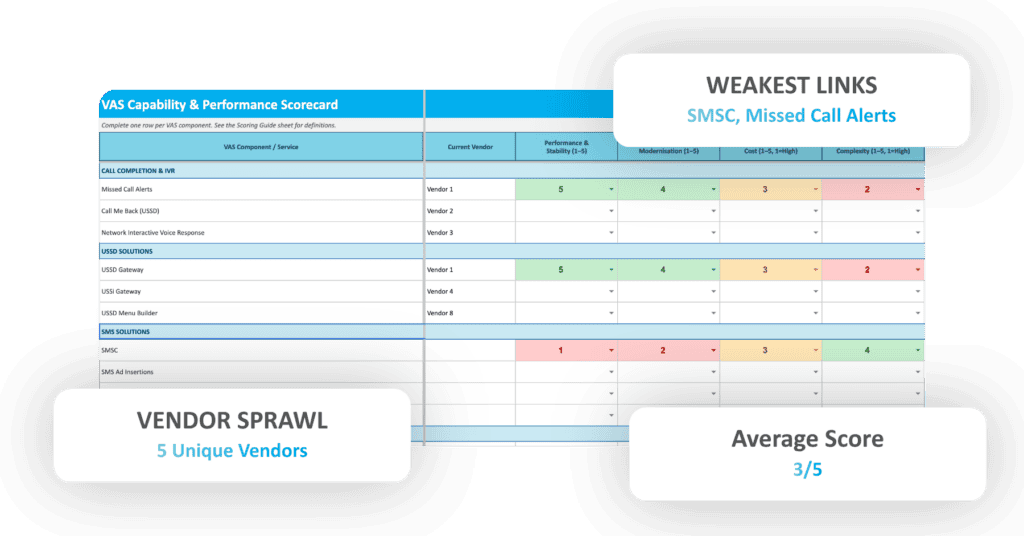
Value-Added Services (VAS) environments often accumulate separate vendors for USSD, SMSC, IVR, and related service platforms. Each vendor operates on its own upgrade cycle, support structure, and integration model. Over time, this creates fragmented support, inconsistent uptime standards, and coordination overhead that compounds at nationwide scale.
Why VAS Is Often the Right Starting Point
Consolidating VAS platforms delivers five clear operational gains:
- Cleaner service management across messaging, USSD, IVR, and notification services
- Fewer vendor handoffs when resolving service incidents
- Stronger uptime consistency through unified monitoring and support
- Faster service rollout when new VAS products share a common platform
- Simpler governance with fewer contracts, SLAs, and vendor review cycles
VAS consolidation is often the most accessible starting point because the overlap between suppliers is visible, the cost duplication is measurable, and the operational gains are felt quickly across both technical and commercial teams.
What Operators Should Assess Before Consolidating Vendors
Before beginning a consolidation programme, operators should evaluate potential vendors and internal readiness against the following eight criteria:
- Platform breadth: Does the vendor cover multiple service layers (messaging, USSD, IVR, billing integration, middleware)?
- Support ownership: Does the vendor provide end to end support, or does responsibility fragment across sub-contractors?
- Escalation clarity: Is there a single escalation path for incidents that span multiple service layers?
- Legacy and Cloud readiness: Can the platform integrate with existing legacy infrastructure and support Cloud based deployment?
- Regional scalability: Can the solution scale across multiple markets, subscriber bases, and regulatory environments?
- Reporting visibility: Does the platform provide consolidated reporting across all service domains?
- Compliance support: Does the vendor support regulatory requirements across the markets the operator serves?
- Long term cost structure: Is the pricing model transparent and aligned to long term TCO reduction?
- Architecture flexibility: Can components be added, replaced, or integrated without forcing a full platform replacement or creating new vendor lock-in?

Vendor Consolidation Becomes a TCO Decision at Nationwide Scale
Vendor consolidation for nationwide telecom networks is a total cost of ownership decision. Fragmented vendor estates increase operational drag through duplicated support, integration overhead, delayed rollouts, and unclear accountability. These pressures compound as networks scale.
For teams ready to quantify the cost of fragmentation across VAS and related service layers, explore The Business Case for VAS Vendor Consolidation which provides a structured starting point.

Matthew Seabrook leads the NGVAS business unit at Adapt IT Telecoms, driving next-gen telecom solutions. With 30+ years in Telecoms, ICT, and IT, his expertise in sales, operations, and professional services enables him to strategize effectively, optimise networks, and unlock new revenue. A servant leader, he fosters growth, removes obstacles, and champions innovation, ensuring lasting partnerships and a thriving, people-centric team.